Alright, let’s be real for a second — having a 3-month-old baby feels like running a marathon in your sleep, right? You’ve survived the newborn chaos (barely), but now your little one is hitting that 3-month milestone and suddenly everything feels… different. The naps are weird, the feedings feel off, and you start wondering if there’s some secret 3 month old schedule that other parents know about but no one bothered to share with you.
Well, guess what? There is. And today, we’re going to talk about the 3 month old schedule no one tells you about — the real one that helps your baby sleep longer, stay happier, and gives you a shot at drinking your coffee while it’s still warm. ☕
Ready? Let’s dive in — or, wait, let’s slide into this topic casually, because no one likes formal intros here.
Why 3 Months Feels Like Starting Over

You’d think by three months in, you’d have this baby thing figured out. But nope. Your little human just leveled up like a baby Pokémon and now needs a new rhythm.
At three months, babies go through massive developmental changes. They’re more alert, their sleep cycles start to mature, and they suddenly realize that day and night are actually different (finally!).
So, why does that matter? Because your old routine might start to fall apart. That’s where a structured 3 month old baby schedule saves your sanity.
Here’s the truth most people skip: this age is about balancing structure with flexibility. You can’t force a strict “clock-based” schedule yet, but you can create a predictable rhythm — and that’s the golden ticket.
Ever notice how your baby gets cranky at the same time every day? That’s your cue! Babies thrive on patterns, even if they pretend not to. 😅
The Secret Behind a Realistic 3 Month Old Schedule
Let’s cut the fluff. You don’t need some complicated, Pinterest-perfect color-coded chart. What you need is a rhythm that works for your baby — one that fits your lifestyle, not the other way around.
Here’s the truth: the perfect 3-month-old schedule doesn’t exist. But there’s a formula that works for most babies: Eat → Play → Sleep (and repeat… forever).
Let’s break that down a bit:
1. Eat (Every 3 to 4 hours)
At 3 months, most babies feed every 3 to 4 hours during the day. That’s roughly 5 to 6 feeds in 24 hours. Whether you’re breastfeeding or bottle-feeding, aim to make daytime feeds fuller so nighttime sleep stretches longer.
Pro tip: Try to feed in a quiet space. Your baby’s brain is like, “Ooh, light! Ooh, noise! Ooh, ceiling fan!” Distractions can mess with intake.
2. Play (Short, Sweet, and Stimulating)
After a feed, your baby’s energy is at its peak — perfect time for some bonding!
Play doesn’t mean a full-blown circus performance. It can be as simple as:
- Tummy time
- Singing silly songs
- Talking face-to-face
- Rattles, mirrors, or colorful toys
Keep it short — around 60 to 75 minutes total awake time, including feeding. Once your baby starts yawning or staring blankly into the void, it’s time to sleep.
3. Sleep (Sweet, Precious Sleep)
Most 3-month-olds need 4–5 naps a day, totaling around 15–17 hours of sleep in 24 hours. Sounds nice, right? Except they don’t always do it when you want them to.
But here’s the good part: your baby is now old enough to start learning sleep cues. That means you can gently guide better naps and longer nighttime sleep.
A Sample 3 Month Old Schedule That Actually Works

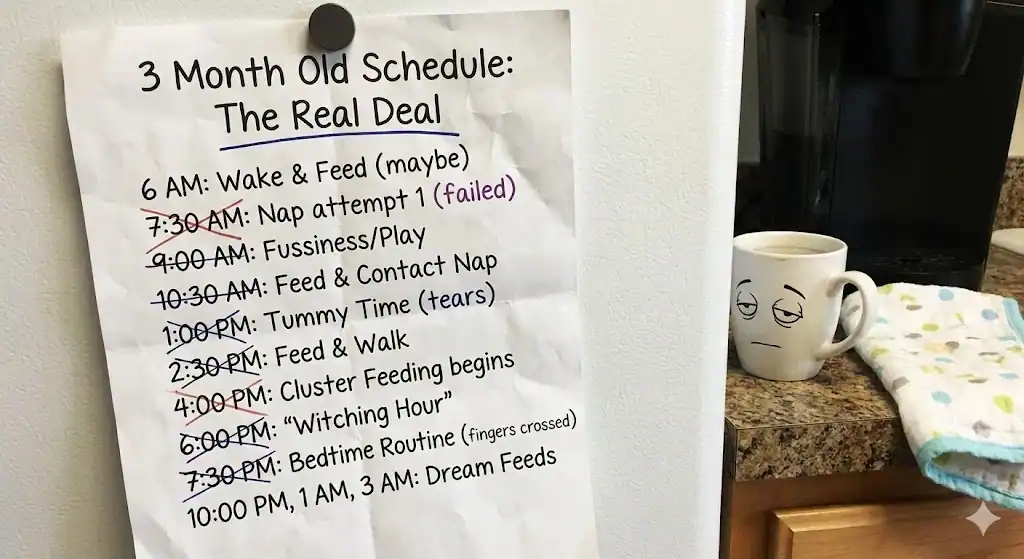
Okay, enough theory. Let’s look at a real sample 3 month old baby schedule — the kind that actually fits into your life instead of running it.
Here’s what a day might look like:
- 7:00 AM — Wake up & Feed. Brighten the room to signal “morning.”
- 8:00 AM — Playtime. Tummy time, songs, gentle stimulation.
- 8:45 AM — Nap #1. Usually lasts 45–60 minutes.
- 10:00 AM — Feed. Keep lights bright to reinforce daytime.
- 10:45 AM — Play. Interaction time — smiles, toys, laughter.
- 11:30 AM — Nap #2. Try to keep this nap calm and quiet.
- 1:00 PM — Feed. Follow with a diaper change and light play.
- 1:45 PM — Play. Gentle activities, soft talking.
- 2:15 PM — Nap #3. Usually shorter. Baby’s energy dips here.
- 4:00 PM — Feed. Cluster feeding helps evening sleep.
- 5:00 PM — Play. Calm, low-energy activities — short walk, cuddles.
- 5:30 PM — Nap #4. Quick 30-min power nap.
- 6:30 PM — Feed. Evening feeding before bedtime routine.
- 7:00 PM — Bath, massage, lullaby. Routine signals bedtime.
- 7:30 PM — Bedtime. Dark room, white noise if needed.
- 10:30 PM — Dream feed (optional). Helps extend night sleep.
Now, does every baby follow this perfectly? Nope. But it’s a solid foundation.
And if your baby decides 4 AM is the new party hour — well, welcome to parenthood. 😅
Why This Schedule Works (Even When Life Feels Messy)
Here’s why this rhythm actually works:
- Predictability = calm. Babies love knowing what’s next. It reduces fussiness big time.
- Balanced wake windows. At 3 months, babies stay awake for 60–90 minutes at a stretch. Too short = no nap. Too long = overtired meltdown.
- Night sleep stretches. Filling your baby’s tummy during the day helps them sleep longer at night. Win-win.
- Parent sanity. Let’s be honest, having a loose schedule helps you plan things like — oh, I don’t know — a shower.
Ever tried showering during “baby free time” only to hear phantom cries every 20 seconds? Yeah, me too. :/
The Baby Sleep Myths You Should Ignore (Seriously)

Let’s address the elephant in the nursery — the endless baby sleep advice floating around the internet. Everyone’s an expert until it’s 3 AM and your baby thinks it’s karaoke night. 🎤
Here are a few myths that you can totally ignore:
Myth #1: You should keep your baby awake all day so they sleep better at night.
Nope. That’s like saying skipping breakfast helps you eat less at dinner. An overtired baby actually fights sleep harder.
Myth #2: You need total silence for naps.
Babies slept through vacuum cleaners in the womb. White noise actually helps — it mimics the womb and keeps them asleep longer.
Myth #3: You’re spoiling your baby by holding them too much.
Wrong again. At this age, your baby still needs contact to feel safe. You’re not spoiling them — you’re building trust.
Myth #4: There’s one perfect schedule for all babies.
If that were true, we’d all be sleeping like royalty. Every baby’s different. The trick is to follow your baby’s cues, not someone else’s Instagram chart.
How to Read Your Baby’s Sleep Cues Like a Pro
Let’s talk about your baby’s secret language — the sleep cues.
You know that moment when your baby rubs their eyes, stares into space, or suddenly becomes quiet? That’s your cue. Put them down then, not when they’re screaming like a rock concert fan.
Common sleep cues include:
- Rubbing eyes or face
- Yawning (obviously)
- Glazed-over eyes
- Sudden fussiness or whimpers
- Turning head away from stimulation
Miss that window, and boom — overtired baby meltdown. Then you’re in the “why won’t they sleep” zone, and it’s not fun.
Nap Transitions and Why They’re So Weird

By three months, naps start to get… interesting. Some are 20 minutes, some are 2 hours. You’ll never know which one you’re getting until it’s over.
This happens because your baby’s sleep cycles are maturing. They start to wake briefly between cycles, and sometimes, they can’t connect them on their own yet.
Here’s how to help:
- Keep the room dark and cool (around 21–23°C).
- Use white noise for consistency.
- Try a soft transition from wake to nap — no overstimulation before sleep.
And please, don’t stress if naps vary. That’s normal. You’re not doing anything wrong. Promise.
Feeding and Sleep — The Sneaky Connection
Here’s a secret that most people miss: feeding and sleep are best friends.
If your baby doesn’t eat enough during the day, they’ll wake up at night to make up for it. So make those daytime feeds count.
Quick feeding tips for 3-month-olds:
- Feed every 3–4 hours.
- Keep nighttime feedings calm — low lights, no playtime.
- Watch for hunger cues (rooting, hand-sucking) before crying starts.
And if your baby still wakes once or twice at night? That’s okay. Their tummy’s still small. You’re doing great.
The Bedtime Routine That Sets You Up for Success

Want to know the biggest “no one tells you” secret? A consistent bedtime routine can work miracles.
Babies thrive on repetition. A short, predictable bedtime routine signals that it’s time to wind down.
Here’s a simple routine that works wonders:
- Bath – warm water relaxes muscles.
- Massage – gentle baby lotion, soft strokes.
- Feed – one last full feed before bed.
- Lullaby or soft music – same song every night helps with association.
- Lights out – dark room, white noise, goodnight kisses.
And yes, you might still get the occasional “party at midnight” moment. But consistency pays off, trust me.
When Things Don’t Go as Planned (Because They Won’t)
Let’s face it — there will be days when your baby skips naps, refuses to eat, or decides to practice “baby yoga” at 2 AM. Don’t panic.
The best thing you can do is stay calm and keep the rhythm. Babies feed off your energy (literally and emotionally).
If one nap’s a disaster, move on. Tomorrow’s a new day. Consistency matters more than perfection.
And hey, even if you only showered once this week — you’re still crushing it. 💪
Real Talk: The Schedule No One Tells You About Isn’t Just for the Baby
Surprise twist — this schedule isn’t just for your little one. It’s for you too.
When you create a rhythm, your brain relaxes. You stop second-guessing every cry. You get tiny pockets of time to breathe, maybe even sip that coffee hot.
Parenthood isn’t about being perfect. It’s about surviving with your sanity intact.
So the real 3 month old schedule no one tells you about? It’s the one that gives both of you balance.
Final Thoughts: You’ve Got This (Even When It Doesn’t Feel Like It)
At the end of the day, every baby is different. Your 3 month old might nap like an angel one day and party like a rockstar the next. It’s normal.
Use the Eat–Play–Sleep rhythm as your anchor, but don’t let it rule your life. Flexibility is your best friend right now.
Remember — babies aren’t robots. They’re tiny, adorable chaos machines, and you’re doing your best to guide them.
So next time someone asks, “How’s the baby sleeping?” just smile, sip your coffee, and say, “Oh, you know — following the schedule no one tells you about.” 😉