
Let’s be real — the 4-month stage can feel like survival mode with a side of confusion, right? One minute your baby is all smiles, and the next, you’re Googling “why won’t my 4-month-old nap?” at 2 a.m. (We’ve all been there 😅). That’s when I realized that having a solid 4 month old schedule wasn’t just helpful — it was life-saving.
If you’ve ever thought, “There’s no way I can get this baby on a schedule,” trust me, you totally can. You don’t need to follow some impossible, military-style routine — you just need something realistic that actually works for your family. And that’s exactly what we’re diving into today. (FYI, there’s no magic wand… but this is pretty close 😉).
So grab your coffee — or that cold cup you reheated three times — and let’s talk about how to create a 4 month old schedule that actually works (without losing your sanity in the process).
Why a 4 Month Old Schedule Matters More Than You Think
Here’s the deal: at four months, babies go through a massive developmental leap. Their sleep cycles mature, they become more aware of the world, and yep — they often hit the infamous 4-month sleep regression. (Cue the dramatic music 🎻).
You might wonder: “Do I really need a schedule right now?” Short answer — YES. Long answer — absolutely YES, but make it flexible.
A consistent routine:
- Helps your baby sleep better. When babies know what’s coming next, they feel secure.
- Makes feeding easier. You’ll spot hunger cues more easily.
- Keeps YOU sane. Because predictability = peace of mind.
When my baby hit 4 months, every day felt like a guessing game. Then I started tracking naps and feeds. Within a week, life went from chaos to “okay, I can actually shower again.” Ever felt that small victory? Pure bliss.
Understanding the 4 Month Old Wake Windows

Before we talk about the actual schedule, you need to know about wake windows — the magic ingredient in baby routines.
At 4 months, your baby’s wake window is typically 1.5 to 2 hours. That’s the time they can stay happily awake before needing another nap. Miss that sweet spot, and hello cranky baby (and probably a missed nap 😬).
Here’s a quick cheat sheet:
- Morning: Wake Window — 1.5 hours; Typical Nap Duration — 1–1.5 hours
- Midday: Wake Window — 1.75–2 hours; Typical Nap Duration — 1–1.5 hours
- Afternoon: Wake Window — 2 hours; Typical Nap Duration — 45 min–1 hour
- Evening: Wake Window — 1.5 hours before bedtime
Sounds simple, right? But don’t worry if your baby’s timing is slightly off — they’re not robots (though that would make nap time a lot easier, huh?).
Sample 4 Month Old Schedule (That Actually Works)

Now let’s get to the good stuff — the realistic 4 month old daily routine that actually works for real families, not just parenting books.
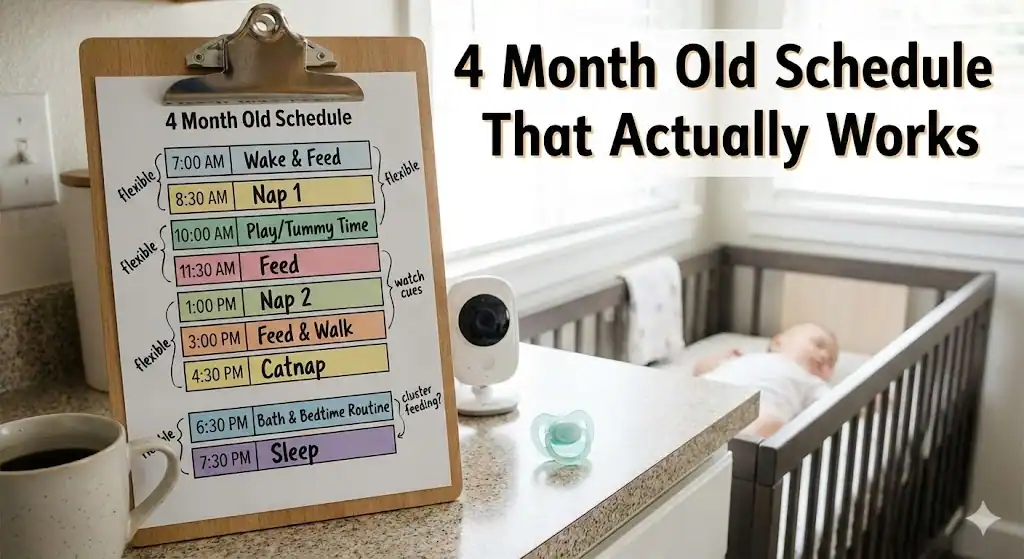
Here’s a sample schedule you can tweak based on your baby’s needs:
- 7:00 AM — Wake up & feed
- 8:30 AM — Nap #1
- 10:00 AM — Wake & feed
- 11:45 AM — Nap #2
- 1:15 PM — Wake & feed
- 3:00 PM — Nap #3
- 4:00 PM — Wake & feed
- 5:30 PM — Short nap (catnap)
- 6:00 PM — Wake & feed
- 7:30 PM — Bedtime routine (bath, feed, snuggles)
- 8:00 PM — Bedtime
- 10:30 PM (optional) — Dream feed
That’s it — no complicated “cry it out” strategies or 15-step bedtime plans. Just structure, balance, and enough predictability to make both you and baby happier.
How Long Should a 4 Month Old Nap?
Ah, the nap question — every parent’s favorite guessing game. The average 4 month old nap lasts 45 minutes to 1.5 hours. But here’s the catch: every baby is different.
If your little one takes shorter naps, that’s okay. Focus more on total daytime sleep, which should be around 3.5 to 4.5 hours spread over 3–4 naps.
Tips for Better Naps:
- Watch wake windows. Don’t wait for yawns — that’s already too late.
- Dark room = better naps. Babies sleep deeper in a darker space.
- Use white noise. It drowns out that random doorbell or barking dog.
- Stay consistent. Napping in the same place daily helps them recognize it’s time to rest.
Trust me, once naps click, everything else (including your mood) improves instantly.
Feeding Schedule for a 4 Month Old

Now, let’s talk milk — because at 4 months, that’s still the main event.
Most 4-month-olds eat about 5–6 times a day, and if you’re lucky, they might even stretch a longer chunk at night (hallelujah 🙌).
Here’s what a typical feeding schedule might look like:
- 7:00 AM – Morning feed
- 10:00 AM – Post-nap feed
- 1:15 PM – Midday feed
- 4:00 PM – Afternoon feed
- 6:30 PM – Pre-bedtime feed
- 10:30 PM (optional) – Dream feed
If you’re breastfeeding, go with your baby’s hunger cues. If you’re formula-feeding, most babies take around 24–32 oz per day.
Ever notice how your baby sometimes snacks like a college student at midnight? That’s okay too. Growth spurts are real, and they can make feeding feel constant for a few days.
What About the 4-Month Sleep Regression?
Ah yes, the dreaded phrase: 4-month sleep regression — a fancy term for “why is my baby suddenly not sleeping?” 😩
Here’s what’s happening: your baby’s brain is growing fast. Their sleep cycles are becoming more like ours — lighter, shorter, and full of brief wake-ups. It’s frustrating but completely normal.
Here’s how to survive it:
- Stick to your routine. Consistency helps babies adjust faster.
- Avoid new habits. Don’t start rocking or feeding to sleep every time they wake up. (Trust me, breaking that later is a nightmare.)
- Use a bedtime routine. A warm bath, soft song, and dim lights signal it’s time to rest.
- Patience. It usually lasts 2–4 weeks. You’ll make it — pinky promise.
Signs Your 4 Month Old Schedule Is Working

So, how do you know your routine’s actually doing its job? Watch for these golden signs:
- Baby wakes up happy (well, mostly).
- Naps last at least 45 minutes.
- Feedings feel more predictable.
- Bedtime isn’t a WWE-level fight every night.
- You actually know when to grab a shower.
If that’s you — congrats! You’ve cracked the code. 🎉
Common Mistakes to Avoid with a 4 Month Old Schedule
Even seasoned parents mess this up (been there, done that, got the spit-up on my shirt). Here are the top mistakes I learned the hard way:
- Over-scheduling. Babies aren’t robots. If you try to stick to exact minutes, you’ll lose your mind.
- Skipping naps. “He doesn’t look tired yet” — famous last words.
- Letting bedtime drift too late. A tired baby doesn’t sleep better — they sleep worse.
- Ignoring wake windows. It’s the difference between peaceful naps and meltdown city.
- Comparing your baby to others. Just don’t. Every baby’s different, and that’s perfectly fine.
Remember, a schedule is a guide, not a law. You’re the expert on your baby — no one else.
Adjusting the Schedule for Growth Spurts and Changes
At 4 months, babies grow like weeds. One week they nap beautifully, the next, they’re boycotting sleep altogether. Totally normal.
When to tweak the schedule:
- Baby starts waking up earlier or later.
- Naps suddenly shorten for several days.
- Feeding patterns shift (hello, appetite surge).
Adjust by moving nap times by 15–30 minutes or offering an extra feed if needed. Small tweaks often fix big problems.
And don’t panic if your baby suddenly decides naps are overrated. It usually evens out once they adjust.
Creating a Calming Bedtime Routine

Want to know the secret sauce to better sleep? It’s not a fancy gadget — it’s consistency. A soothing bedtime routine tells your baby, “Hey, it’s time to chill.”
Here’s a simple one you can follow:
- Warm bath (babies love it).
- Dim lights and soft lullaby.
- Feed in a quiet room.
- Cuddle time — this part is magic.
- Down to sleep, slightly drowsy but awake.
Keep it short, predictable, and sweet. Before long, your baby will start associating these steps with sleep time — and that’s the real win.
What If My 4 Month Old Still Doesn’t Sleep Well?
You might be thinking, “I’ve tried all this, and my baby still wakes up like five times a night!” I hear you. Sometimes, even the best schedules take time to stick.
Here’s what might be going on:
- Baby’s still adjusting to longer wake windows.
- Teething or growth spurts (they sneak up on you).
- Too much daytime sleep or too little.
- Environment too bright or noisy.
It’s okay if it’s not perfect. Progress beats perfection. IMO, the goal isn’t a textbook-perfect schedule — it’s creating balance that works for your baby and your sanity.
Final Thoughts: You’ve Got This, Parent!
Let’s wrap it up. Building a 4 month old schedule that actually works isn’t about perfection — it’s about rhythm. Once you understand your baby’s cues, wake windows, and feeding needs, everything clicks into place.
Sure, you’ll still have off days (hello, growth spurts 👋), but having a flexible routine gives you control amidst the chaos.
So next time your baby’s nap goes sideways or bedtime takes forever, remember: you’re doing amazing. Every little adjustment you make helps your baby (and your sanity).
Now go grab that coffee, breathe, and pat yourself on the back — because figuring out a 4 month old schedule that works? That’s no small feat. You’ve got this. 💪🙂