If you’re staring at your baby, coffee in hand, wondering “Is it time for a nap or a bottle or both?”—welcome to the club, my friend. I’ve been there. At 2 months, babies are adorable little bundles of joy who somehow also run your entire life on chaos and cuddles. But good news—there’s a 2 month old schedule that actually works, and it’s the one every mom seems to be raving about right now (and for good reason).
I used to think having a “baby schedule” at 8 weeks was some Pinterest mom fantasy. But once I got my little one into a rhythm, everything—feeding, sleep, and my sanity—started falling into place. So if you’re ready to get your life (and your coffee breaks) back, let’s chat about what actually works for a real 2-month-old baby schedule.
Why Having a 2 Month Old Schedule Actually Matters
You might wonder, “Can a 2 month old even have a routine?” Yes—and no. Babies this age aren’t robots (shocking, I know 😅). They still need flexibility, but having a predictable pattern helps both you and your baby feel more settled.
Here’s why it makes a huge difference:
- Better sleep for everyone. A consistent rhythm teaches your baby’s body when to rest.
- Easier feedings. When your baby knows what’s coming next, fussing goes down (and so do those random hunger cries at 3 a.m.).
- Calmer days. Predictability helps reduce overstimulation—a real thing at this age!
- You feel more in control. Because let’s face it, when you have a newborn, control feels like a myth.
So no, this isn’t about strict rules. It’s about finding a flow that works for you and your baby.
Understanding a 2 Month Old’s Wake Windows and Sleep Needs

Before we jump into the schedule, let’s talk wake windows—your new favorite parenting term.
A wake window is simply how long your baby can stay awake before needing sleep again. At 2 months, that’s usually between 60–90 minutes. Yes, you read that right. Just as you start a cup of coffee, your baby is ready for another nap.
Here’s what most 2-month-olds need in a 24-hour period:
- Total sleep: 14–17 hours (crazy, right?)
- Daytime naps: 4–6 naps totaling around 6–8 hours
- Night sleep: Around 8–10 hours (with 1–3 night feeds)
Every baby’s different, so don’t panic if yours doesn’t match this to the minute. But using these as guidelines helps you spot when your little one’s getting tired before the meltdown begins.
The 2 Month Old Schedule That Actually Works
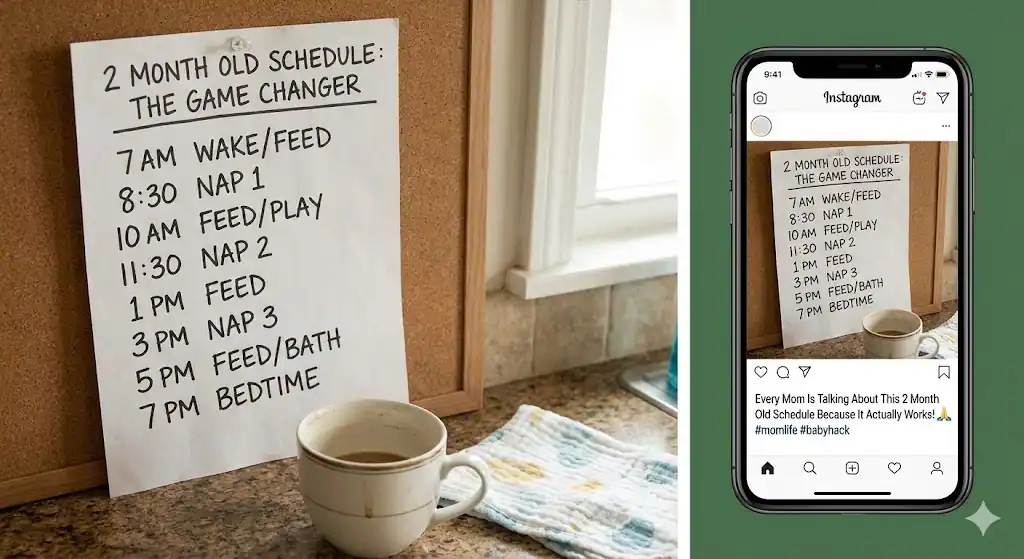
Alright, here’s the good stuff—the realistic daily schedule that countless moms (including me) swear by. Whether you’re breastfeeding, formula feeding, or combo feeding, this plan works for both.
Sample Daily Schedule for a 2 Month Old (Mixed Feeding)
| Time | Activity | Details / Notes |
|---|---|---|
| 7:00 AM | Wake Up + Feeding | Feed (breast or bottle), diaper change, morning cuddles. Keep lights bright to help baby learn “morning.” |
| 8:15 AM | Nap #1 | Short nap (45–60 mins). This first nap sets the tone for the day! |
| 9:15 AM | Feeding + Playtime | Feed again. Do some tummy time or gentle play (singing, baby gym, mirror time). |
| 10:30 AM | Nap #2 | Another short nap (about 1 hour). Keep the room dim and quiet. |
| 11:30 AM | Feeding | Offer breast or bottle. Keep baby upright after feeding to reduce spit-up. |
| 12:30 PM | Nap #3 | Usually around an hour. Perfect time for you to rest too. 😉 |
| 1:30 PM | Feeding + Walk | Fresh air helps baby nap better later. A stroller walk counts as playtime! |
| 3:00 PM | Nap #4 | A solid 1-hour nap if possible. Some babies take shorter catnaps here. |
| 4:00 PM | Feeding + Gentle Play | Keep play low-key. Think lullabies or soft talking. |
| 5:30 PM | Nap #5 (Catnap) | Super short—20 to 30 minutes max. Helps bridge to bedtime. |
| 6:30 PM | Feeding + Bath | Evening feeding followed by a warm bath or massage. Helps baby relax. |
| 7:00 PM | Bedtime Routine | Dim lights, soft lullaby, one last cuddle. Bedtime feed (breast or bottle). |
| 7:30–8:00 PM | Sleep for the Night | Aim for a longer stretch (4–6 hours if you’re lucky!). |
| Midnight–2:00 AM | Night Feed | Quick feed, no play, keep lights off. Straight back to sleep. |
| 4:00–5:00 AM | Early Morning Feed | Another quick feed. Baby usually goes right back down. |
Real Talk: What “Actually Works” Means

Let’s get honest—no schedule works perfectly every day. Some days your baby will nap like a dream; other days, you’ll feel like a human pacifier. And that’s totally fine.
When moms say this “2 month old schedule actually works,” they don’t mean it’s magic. They mean:
- Their babies started sleeping longer stretches at night.
- Feedings became more predictable (aka fewer random cluster feeds).
- The day finally had some structure instead of total chaos.
And honestly, that’s the win. Not perfection—just progress.
How to Build Your Own Version of the Schedule
Every baby is unique, so think of this as a framework, not a formula. Here’s how to personalize it:
1. Watch for Sleep Cues
Those adorable yawns, glazed eyes, and sudden quiet moments? That’s your baby saying, “I’m done, mom.” Don’t miss the window or you’ll hit meltdown city.
2. Keep a Flexible Feeding Routine
At 2 months, most babies feed every 2.5–3 hours. Some still cluster feed in the evenings (because why not? 😅).
- Breastfed babies may snack more often.
- Formula-fed babies might go longer between feeds.
- Combo-fed babies—you guessed it—land somewhere in the middle.
3. Use Wake Windows, Not the Clock
If your baby wakes early from a nap, adjust the next nap time based on their awake window. Rigidly following the clock can backfire.
4. Anchor the Day Around Morning and Bedtime
Even if naps shift, keep wake-up and bedtime consistent. This helps set your baby’s circadian rhythm (aka their internal “day/night” clock).
How Long Should a 2 Month Old Nap?

Ah, the nap roulette game. At this age, expect naps to last anywhere from 30 minutes to 2 hours. If you get a 2-hour nap, celebrate! (Seriously, take a shower, eat something warm, or just stare at a wall in silence—it’s the little things.)
Pro tip: Contact naps are totally fine. Your baby’s brain is growing fast, and sometimes they just want the comfort of your heartbeat. Enjoy it—it won’t last forever.
Feeding Tips for 2 Month Olds (Breast + Bottle Mix)
Feeding can feel like a full-time job right now. Here’s what most parents find works best:
- Feed every 2.5–3 hours during the day.
- Expect 5–7 feeds total in 24 hours.
- Night feeds: 1–3 depending on baby’s growth and appetite.
- Amount: Around 3–4 oz per feed (bottle) or 10–15 minutes per breast.
And yes, if your baby cluster feeds before bed, that’s normal. They’re “tanking up” for the night—kind of like how we stock up on snacks before a Netflix binge.
Nighttime Routine That Actually Helps Baby Sleep Longer
Here’s where many parents (including me) saw the biggest difference. Creating a calm, predictable bedtime routine signals to your baby that sleep is coming.
Keep it simple and repeat it every night in the same order:
- Warm bath or gentle wipe-down
- Fresh diaper + cozy sleep sack
- Dim lights
- Soft lullaby or white noise
- Feed (breast or bottle)
- Quick cuddle, then bed
The key is consistency—not perfection. Some nights you’ll skip a step (hello, overtired meltdown), and that’s okay.
What About Growth Spurts and Sleep Regressions?

Oh, the 2-month growth spurt—good times 😅. Around 6–9 weeks, your baby might suddenly:
- Want to eat every hour
- Sleep less (or only on you)
- Get cranky for no reason
It’s temporary, promise. Stick to your rhythm, comfort your baby, and once the spurt passes, the schedule falls right back into place.
A Few Sanity-Saving Tips from One Mom to Another
Because let’s be honest, a schedule is great—but so is staying sane.
- Don’t compare. Every baby develops differently. Instagram moms lie, FYI 😉
- Track naps and feeds for a few days to spot patterns.
- Go outside daily. Fresh air = better naps (for both of you).
- Embrace shortcuts. If the baby naps in the swing safely supervised—fine. If you skip a diaper change mid-nap—also fine. Survival mode counts.
- Ask for help. Even superheroes need a sidekick.
Common Mistakes Parents Make With a 2 Month Old Schedule
Let’s skip the sugar-coating. Here are a few traps to avoid:
- Trying to force a strict routine too early. Flexibility is key.
- Skipping wake windows. Overtired babies fight sleep like it’s a sport.
- Keeping baby up too long before bedtime. More tired ≠ better sleep.
- Ignoring nighttime cues. Quick, calm feeds work best—don’t turn on the lights or start playtime.
- Comparing your baby’s naps to others. Seriously, don’t. Every baby’s internal clock is unique.
What Other Moms Are Saying About This Schedule

I’ve shared this schedule in mom groups and with my new-parent friends, and the feedback is almost always the same:
“I finally feel like I know what’s going on.”
“My baby sleeps better, and I actually get time to eat lunch.”
“It’s not perfect every day, but wow—what a difference.”
That’s the magic of this schedule—it’s realistic. It works for working moms, stay-at-home moms, and everyone in between.
When to Adjust the Schedule
Your 2-month-old will hit new milestones fast, and by 3–4 months, wake windows will stretch to 1.5–2 hours. That’s your cue to tweak nap times and possibly drop a nap.
A quick sign your schedule needs an update:
- Baby suddenly resists naps.
- Night wakings increase.
- Feedings shift earlier or later consistently.
Small adjustments keep things flowing smoothly without starting over.
Final Thoughts: The Schedule That Actually Lets You Breathe Again
So yeah, this 2 month old schedule really does work. Not because it’s perfect, but because it gives you a framework that fits real life—spit-up, blowouts, and all.
It helps your baby feel secure and helps you feel like you’ve got this parenting thing (mostly) under control. Will every day go smoothly? Absolutely not. But you’ll start seeing patterns, your baby will start sleeping better, and you might even finish that cup of coffee while it’s still hot ☕.
So if you’ve been searching for the baby schedule that actually works, this is it. Try it, tweak it, and make it your own. Because at the end of the day, you’re the expert on your baby.