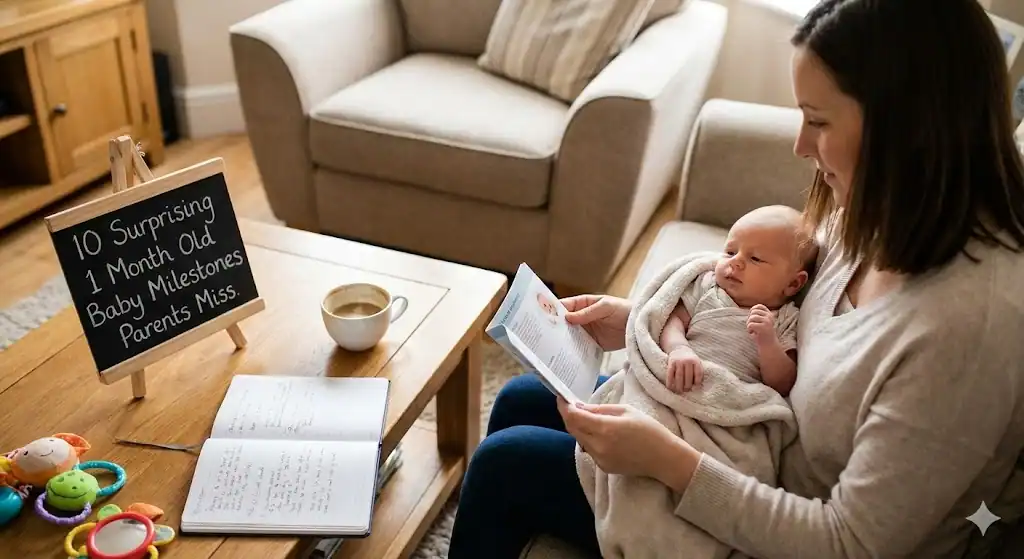
Let’s be real — when you have a one-month-old baby, you’re running on caffeine, hope, and maybe three hours of sleep (on a good day). You’re busy googling things like “why does my baby make weird faces when sleeping?” and “how long can I survive without sleep?” (FYI: not long 😅). But here’s the thing — your tiny human is already hitting some amazing milestones, even if they’re sneaky about it.
So, if you think your one-month-old only eats, cries, and poops — surprise! There’s actually a lot more happening behind those adorable (and slightly cross-eyed) baby gazes. Let’s uncover 10 surprising 1-month-old baby milestones parents often miss, plus what they actually mean for your baby’s early development.
Grab that lukewarm cup of coffee, and let’s talk baby magic!
1. The “I Know Your Voice” Moment

Ever notice how your baby suddenly goes quiet when you start talking? That’s not your imagination — your little one already recognizes your voice!
At just one month old, your baby’s auditory senses are sharp enough to differentiate between familiar and unfamiliar sounds. They’ve been listening to your voice since their days in the womb, so it’s like their favorite soundtrack. (Sorry, Beyoncé, Mom wins this round.)
You might see your baby turn their head slightly when you speak or even calm down when they hear you. That’s their version of saying, “Hey, I know you! You’re my person!”
Pro tip: Talk to your baby often — describe what you’re doing, sing, or just narrate your day. You’re not just bonding; you’re helping their brain develop language recognition. Cool, right?
2. Those Little Reflexes Are Big Deals
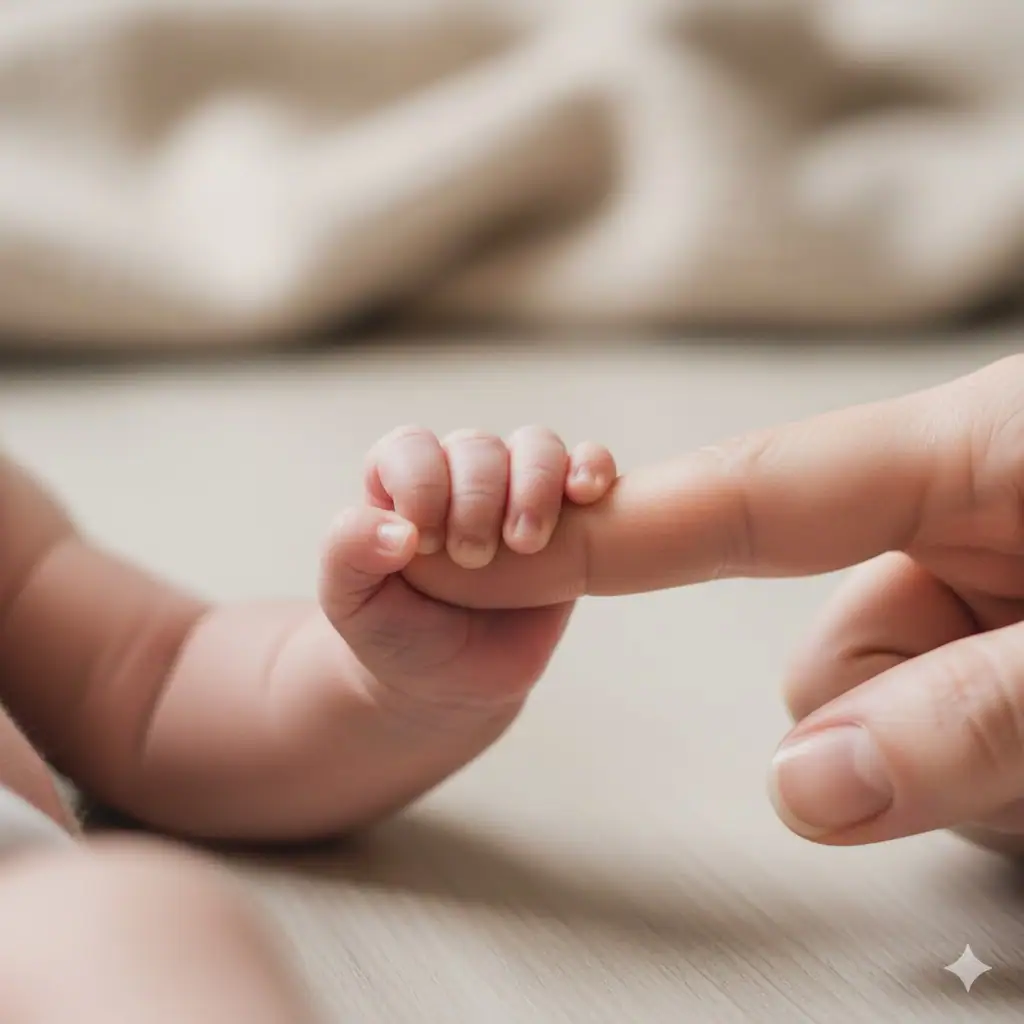
Okay, you’ve probably noticed your baby has some wild reflexes — like when they spread their arms suddenly as if they just fell off an invisible cliff (that’s the Moro reflex). Or when they grab your finger with their tiny hand and hold on for dear life.
These reflexes might seem random, but they’re actually signs of a developing nervous system. Here’s a quick rundown:
- Moro Reflex: That sudden startle movement means their nervous system is alert and responsive.
- Rooting Reflex: When you touch their cheek and they turn their head toward it — that’s how they find food!
- Grasp Reflex: When your baby’s hand wraps around your finger, it’s more than adorable — it’s a primitive survival instinct.
These reflexes show that your baby’s body and brain are learning to work together. Think of it as their first step toward mastering movement — baby edition!
3. The “Social Smile” That Melts Hearts

Alright, let’s talk about that smile. You know, the one that makes you forget all the sleepless nights and endless diaper changes? Yup, that’s starting to appear around now!
By one month, babies begin to smile in response to familiar faces or voices — not just from gas (even though those gas smiles are pretty convincing 😅).
That first real smile is your baby’s way of saying, “Hey, I like you!” It’s a huge emotional and social milestone because it means they’re starting to connect with the world.
Pro tip: Smile back! Make silly faces, coo, and interact. This helps your baby learn emotional expression and boosts their confidence (yes, babies can totally feel proud of themselves).
4. They’re Already Trying to “Talk”

Surprise! Your one-month-old isn’t just crying — they’re communicating.
If you listen closely, you’ll notice your baby experimenting with different sounds and tones — grunts, coos, and those adorable little “ah” noises. This is the foundation of speech, folks!
Your baby is basically learning how to control airflow and vocal cords. Wild, right?
You can encourage this by “talking back.” When your baby coos, respond as if you’re having a full-blown conversation. Sure, you’ll sound ridiculous — but your baby loves it!
Fun fact: Babies who are engaged in this kind of early “talk” often develop better language skills later on. So, chat away, superstar parent. 🙂
5. The Eye Contact Game Is Strong

One of the most underrated one-month milestones is eye tracking — when your baby locks eyes with you or follows an object with their gaze.
At this stage, babies can see objects about 8–12 inches away, which happens to be the perfect distance from your face during feeding. Coincidence? Nope — it’s evolution doing its thing.
If you notice your baby staring at your face like you’re the most fascinating thing in the world — that’s because, to them, you are.
Try this: Move a colorful toy slowly from side to side. If your baby follows it with their eyes, congrats — they’re already practicing visual coordination.
6. They’re Building Serious Neck Strength

Heads up (literally)! Around the one-month mark, your baby starts trying to lift their head during tummy time or while lying on your chest.
It might look like a small movement, but it’s a massive milestone in terms of motor development. Their neck muscles are starting to strengthen — a key step before sitting, crawling, and eventually walking.
Tummy time (short sessions while your baby is awake and supervised) helps them build those tiny muscles safely. Start with 2–3 minutes a few times a day and gradually increase the duration.
And yes, they might protest at first (babies have strong opinions, who knew?), but it’s worth it. You’ll thank yourself later when your little one starts rolling around like a champ.
7. They’re Already Learning to Self-Soothe

Now, this one often flies under the radar. Some babies, even at one month old, start to self-soothe — meaning they can calm themselves for short moments.
You might catch your baby sucking on their hand or turning their head away when overstimulated. These tiny actions are signs of emotional regulation (fancy term for “learning to chill out”).
Of course, don’t expect your baby to handle stress like a Zen master yet — but it’s a good sign that they’re developing coping skills early on.
Parent hack: If you notice your baby using their hands to self-soothe, give them space to practice it. You’re helping them build independence (even if it’s for just 10 seconds 😅).
8. The Sleep Patterns Start Taking Shape

You might be thinking, “Sleep pattern? What sleep pattern?” — and fair enough. But even in the chaos of newborn life, your baby’s sleep-wake cycles are starting to organize themselves.
At one month, babies begin to have shorter periods of alertness followed by longer naps. You might notice they’re more awake during the day (for like, an hour) and sleepier at night — which, IMO, is nature’s way of saying, “You’re doing great, keep going.”
Here’s what’s happening:
- Their circadian rhythm (the internal clock that tells us day from night) is starting to develop.
- Their brain is beginning to consolidate sleep — meaning deeper, more restful naps.
If you’re seeing a little more consistency (even just a bit), celebrate it. You’re moving from “zombie mode” to “semi-functional human” — progress!
9. Their Movements Are Becoming More Coordinated

At first, your baby’s movements might look jerky and random — like a tiny robot learning how to human. But by one month, those flailing arms and legs are becoming more controlled and purposeful.
You might see your baby kick their legs when excited or wave their arms when hungry. This coordination means their motor control is improving, and their brain is forming essential connections between neurons.
Try this fun test: Lay your baby on a soft blanket and watch them move. Are they starting to reach toward their face or stretch out more smoothly? That’s progress!
And yes, it’s adorable — but it’s also the groundwork for reaching, grabbing, crawling, and eventually running around your house like a tornado.
10. They Already Have Preferences (Yes, Really!)

Believe it or not, your one-month-old already has likes and dislikes.
They might prefer one side while feeding, get calmer when hearing certain songs, or respond differently to bright versus dim lighting.
Babies are already building their sensory preferences — smells, textures, voices, and even faces. It’s their way of starting to understand the world around them.
You might notice:
- They get quiet when you play a familiar lullaby.
- They love being held a certain way.
- They fuss when it’s too noisy or too bright.
Recognizing these early preferences helps you learn your baby’s personality (yes, they already have one!).
Bonus Milestone: You’re Becoming a Pro Parent
Let’s not forget the unsung hero here — you.
You’re learning to understand your baby’s cries, decode those adorable (and confusing) expressions, and anticipate their needs like a mind reader.
That’s not luck — that’s bonding, experience, and pure parental instinct kicking in.
You’re growing right alongside your baby, and IMO, that’s just as important as any milestone they hit.
How to Encourage These Early Milestones
If you’re wondering how to support your one-month-old’s development without overthinking it, here’s a quick cheat sheet:
- Talk often: Your voice is their favorite sound — use it.
- Smile and make eye contact: Builds emotional connection and recognition.
- Tummy time daily: Strengthens muscles and coordination.
- Respond to their cues: You’re teaching them trust and communication.
- Keep it calm: Babies thrive on gentle stimulation — not sensory overload.
These small actions help shape your baby’s brain, body, and emotions — all while creating that heart-melting bond you’ll never forget.
Common Myths About 1-Month-Old Milestones
Let’s clear up some of the common myths that can stress out new parents (because you don’t need more of that right now).
Myth #1: “My baby isn’t smiling yet, something’s wrong!”
→ Chill 🙂 Every baby develops at their own pace. Some smile at 4 weeks, others at 6 or 7 — totally normal.
Myth #2: “Tummy time has to be long.”
→ Nope. A few minutes several times a day works wonders. Quality > quantity here.
Myth #3: “Babies can’t learn this early.”
→ Oh, they can — and they do! Their brains are making millions of neural connections per second. You’re basically raising a mini genius.
So, no pressure.
Why These Milestones Matter (Even When They Seem Small)
Every little milestone — from that first coo to the way they turn their head — is part of a much bigger picture.
These early skills are the foundation for:
- Speech and communication
- Social interaction and emotional regulation
- Motor development and coordination
Think of it like building a house — these are the bricks that hold everything together later on. Skipping or missing them isn’t a “failure” — babies just progress at different speeds.
But being aware of them? That helps you celebrate every tiny victory (and trust me, there are many).
When to Talk to Your Pediatrician
Okay, real talk — most babies hit milestones within a wide range of time. But if you’re worried (because that’s literally part of the parenting job description), here are a few red flags worth mentioning to your doctor:
- Baby isn’t reacting to sounds or your voice.
- Baby doesn’t make eye contact at all.
- Very floppy or stiff body movements.
- Not feeding well or always excessively sleepy.
Most of the time, everything’s totally fine — but if something feels off, your pediatrician will guide you. Trust your gut — it’s there for a reason.
Final Thoughts: Celebrate Every Little Win
Here’s the thing: you don’t need to track every milestone on a chart or freak out if your baby isn’t doing exactly what another baby is doing.
Your one-month-old is changing faster than you realize, and those little daily moments — the eye contact, the smiles, the tiny hand holding your finger — they all count.
So, take a deep breath. Enjoy the chaos. Laugh at the mess. Because before you know it, that one-month-old will be crawling, walking, and asking you “why?” a hundred times a day.
And when that happens, you’ll look back and think, “Wow, we made it through those sleepless nights after all.”
You’ve got this, parent. ❤️