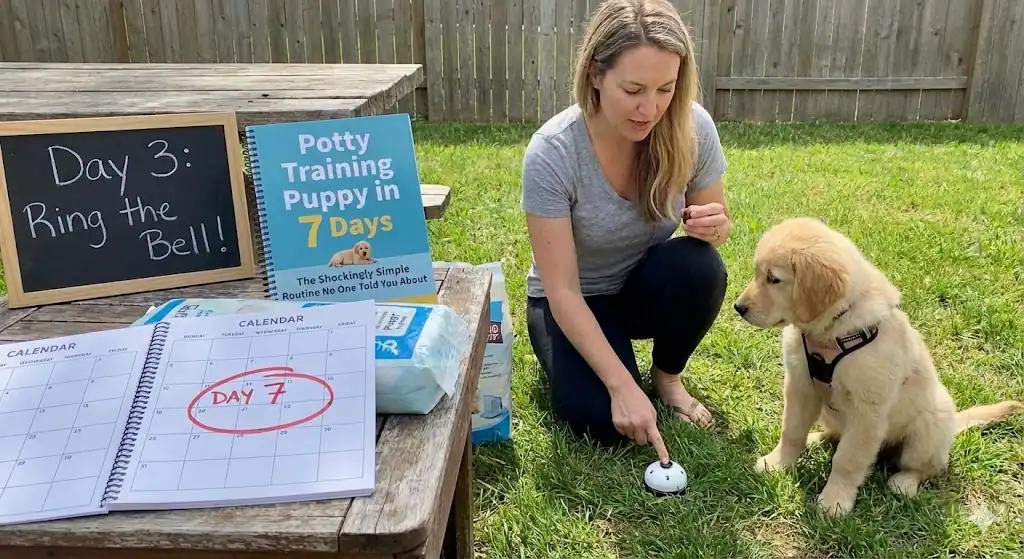
Let’s be honest, you’re here because there’s a new, suspiciously damp spot on your carpet, and you’re wondering if you’ve made a terrible, albeit adorable, life decision. You’ve probably heard the boasts: “My puppy was trained in a weekend!” You’ve also heard the horror stories. But “potty training puppy in 7 days”? It sounds like a marketing gimmick, right? Like a “lose 30 pounds by next Tuesday” kind of scam.
I was skeptical too, until I realized the “secret” isn’t a secret at all. It’s a shockingly simple routine that’s less about the puppy and more about you becoming a temporary, caffeine-fueled, treat-dispensing stalker. The part no one tells you is that this “simple routine” is a 7-day boot camp where you are the one being trained. But if you stick with it, the results are absolutely real.
Before Day 1: The “Pre-Potty” Prep (Your Shopping List for Sanity)

You can’t just wake up on a Tuesday and decide “this is the week” without any prep. That’s a one-way ticket to frustration and a house that smells like a kennel. Before your 7-day timer officially starts, you need to go on a shopping spree, not for cute sweaters, but for your sanity-saving arsenal. This is the foundation of the entire operation.
My first puppy, a beagle who was far too smart for his own good, taught me that being unprepared is basically just agreeing to let a tiny animal ruin all your flooring. Don’t be like I was. Go to the store with a list and a sense of purpose. You are preparing for battle, my friend, and you need the right weapons.
Gearing Up: The Non-Negotiable Arsenal
Forget what you think you need; this is the real-deal list. This isn’t about luxury, it’s about survival. Every single item on this list plays a critical role in the 7-day plan, and skipping one will create a massive headache for you later. Trust me, when it’s 3 AM and you’re cleaning up a mess, you’ll wish you had listened. The right gear turns an impossible task into a manageable one.
- A Crate: This is not a “puppy jail.” It’s their private bedroom, their den, and your single greatest potty-training tool. Dogs are naturally clean and will avoid soiling where they sleep, which teaches them the magic, life-changing skill of holding it.
- Enzyme Cleaner: I’m putting this in bold again because it’s that important. DO NOT use a regular carpet cleaner. The ammonia in puppy pee is a biological “restroom” sign. An enzyme cleaner uses good bacteria to eat the organic matter, permanently destroying the scent. Without it, you’re just inviting them back to the same spot.
- High-Value Treats: We’re not talking about their boring kibble. We need the good stuff: tiny pieces of hotdog, cheese, or freeze-dried liver. These treats should be so amazing that your puppy would consider writing a sonnet about them. These are only for successful potty trips.
- A Leash (for indoors): Yes, you read that right. In the first few days, the puppy should be leashed to you when they are out of the crate. It sounds crazy, but it’s the only way to guarantee 100% supervision.
- Baby Gates / Playpen: You need to create a “containment zone.” This is a small, puppy-proofed area where they can be when not in the crate or leashed to you. This limits their opportunities to sneak off and find a “secret” potty spot.
The Mindset Shift: You Are Now a “Puppy Papparazzo”

This is the “shocking” part of the routine no one likes to talk about. For seven days, your new full-time, unpaid job is “Puppy Supervisor.” Your goal is 100% supervision. This means the puppy is never out of your sight for a single second. Why? Because you are now a detective, and you are looking for clues.
The second you see a “tell”—circling, sniffing the ground intently, a sudden pause in play—you spring into action. This is not passive. You can’t be checking your phone or binging a new series. You must be present. This is what “potty training” really is: it’s not the puppy learning, it’s you preventing accidents so the good behavior (going outside) is the only option.
The “Shockingly Simple” Routine: A 24-Hour Breakdown
Okay, here is the core of the entire “potty training puppy in 7 days” system. It’s not magic, it’s math. A new puppy (8-12 weeks) has a bladder the size of a walnut and the self-control of a goldfish. They can physically hold it for about 1-2 hours, max. But here’s the catch: that’s when they are resting.
When they are active, eating, or drinking, that timer drops to minutes. Your job is to beat the clock. The routine is simple: you create a high-frequency schedule that gives them zero opportunity to fail. This schedule will feel absolutely relentless, but it’s the only way to hardwire the new habit in just 7 days.
The Golden Rule: “When in Doubt, Take ‘Em Out”
You are going to feel like a human revolving door, and that’s exactly how it should be. A puppy must be taken to their designated potty spot at several key moments, without exception. This is the non-negotiable list that you will live by for the next 168 hours.
- Immediately after waking up (from nighttime sleep and from any nap, no matter how short).
- Immediately after eating (their digestive system is a high-speed train).
- Immediately after drinking (what goes in, must come out).
- Immediately after a play session (excitement stimulates the bladder).
- Right before being put in the crate (even for a few minutes).
- Right before you go to bed for the night.
- …And every 30-45 minutes in between if they are out of the crate and active. Yes, you read that correctly. Every. 30. Minutes.
What “Taking ‘Em Out” Actually Means

This is where so many well-intentioned owners fail. “Taking them out” is not a fun walk in the park. It is a boring, specific, goal-oriented mission. You must leash the puppy (even if your yard is fenced), carry them to the exact same spot every single time (this helps them build a scent association), and stand there like a statue. You will say your “potty cue” (a simple phrase like “go potty” or “be quick”) in a calm, neutral-bordering-on-bored-voice.
You do not play. You do not scroll on your phone. You wait. It might take 10 minutes, but you wait. The second they finish, the instant they are done, you throw a “potty party.” You become a Vegas show: “GOOD DOG! YES! GOING POTTY! YOU’RE THE BEST DOG!” all while delivering those high-value treats. Then, and only then, do you play for 5 minutes as a reward.
The 7-Day Boot Camp: A Day-by-Day (ish) Guide
This is it. This is the week. The “7-Day” part of the title isn’t a guarantee that your puppy will be 100% bomb-proof by Day 8. It’s a 7-day intensive boot camp to install the basic software. You are building the foundation. So, take a deep breath, brew a giant pot of coffee, and let’s get started.
The goal of this week is not “zero accidents” (though that’s nice); the goal is maximum prevention and maximum reinforcement. This is what separates the people who are still cleaning puddles in six months from the people who are done in one week.
Days 1-3: Maximum Security (And Zero Fun for You)
Welcome to the trenches. These first three days are, frankly, going to suck. This is the “shock” part. Your puppy is in one of three places, no exceptions: 1) In their crate. 2) On a leash, physically attached to your body. 3) In their designated potty spot with you. That’s it. There is no “oh, let me just let him wander while I make a call.” That’s when accidents happen.
You will be taking them out every 30-45 minutes. You will be waking up at least 2-3 times a night to take them out (sorry, their bladders can’t make it 8 hours). This is pure, unadulterated management. You are a full-time, unpaid Potty Supervisor. Your only job is to prevent failure and reward success.
Days 4-5: The “Aha!” Moment (Maybe)
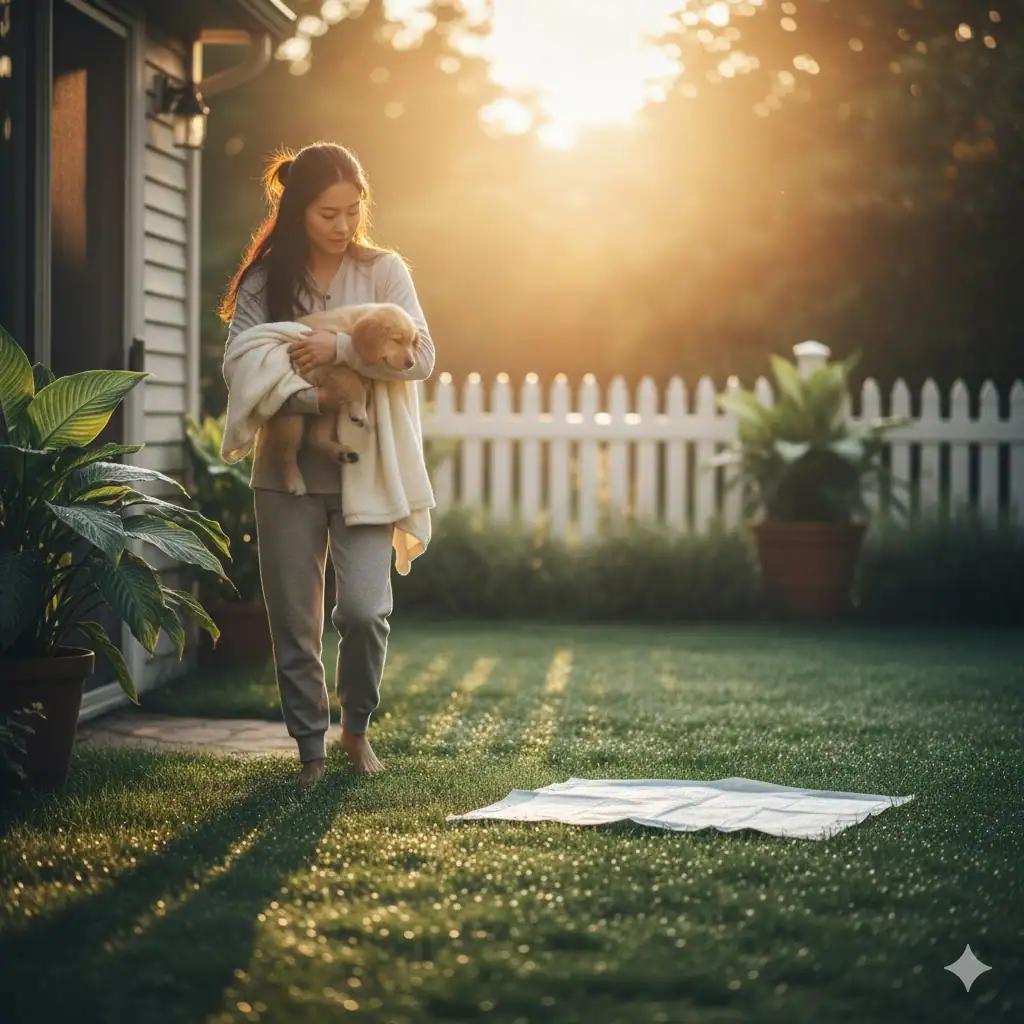
If you have been 100% consistent, somewhere around Day 4 you might see a glimmer of hope. Your puppy, who has been taken to the same spot 8,000 times, might start to get it. You might see them pause play and run to the back door on their own. You might see them sniff the spot where their leash hangs. When this happens, you must react as if they just won the lottery.
Drop everything, praise them like a hero, and sprint outside with them. This is the “Aha!” moment. This is the connection forming in their brain. But—and this is a big but—do not let up. This is the classic “false dawn.” The second you think “oh, he’s got it” and give them free-roam, they will have an accident. Stay the course. You can maybe stretch the time between trips to 60-90 minutes, but only if you’re feeling lucky.
Days 6-7: Establishing the New Normal
By now, you and your puppy should be in a rhythm. It should feel less like a military operation and more like a (still very annoying) routine. Your puppy probably slept for a longer stretch last night. They are likely waiting by the door in the morning instead of just peeing in their crate (or on your floor). This is the time to cement the habit.
You are still supervising, but you can start to transition from the indoor leash to the playpen. They are still not “trained.” They are just “on the program.” The goal for Day 7 is to have a puppy who clearly understands where to go (outside, in the spot) and who to tell (you). This 7-day boot camp is the rocket launch; it gets them into orbit, but you still have to steer the ship.
The “Oh Crap” Manual: What to Do When It All Goes Wrong

Accidents are going to happen. Let me repeat that. Accidents. Will. Happen. The 7-day plan is about minimizing them to near-zero, but at some point, you’ll blink, and there will be a puddle. How you react in that 5-second window will either set your training back two weeks or be a minor blip. This is the troubleshooting guide for when (not if) things go sideways. The key is to never, ever panic. Your puppy isn’t doing it to spite you; they’re doing it because they’re a baby with no bladder control.
Help! My Puppy Had an Accident! (Hint: Don’t Yell)
First, a hard truth: if your puppy had an accident inside, it is 100% your fault. You either weren’t supervising, you missed their cues, or you waited too long. So, what do you do? First, what you don’t do: DO NOT yell, scold, or (and I can’t believe I still have to say this) rub their nose in it. That ancient, terrible “advice” will only teach your puppy that you are a terrifying, unpredictable monster, and that they should find a better, more secret place to pee next time (like behind your sofa).
If you catch them in the act, make a sudden, startling noise—a sharp “Ah-ah!” or a clap—just enough to interrupt them. Then, scoop them up mid-stream if you have to, and run (don’t walk) outside to their spot. If they finish out there, throw a party. If you find the mess later, just clean it up silently with your enzyme cleaner and promise yourself you’ll supervise better.
Crate Training Isn’t Cruel (Unless You’re Doing It Wrong)
I hear this all the time: “I just feel so bad putting them in a cage!” Let’s reframe. It is not a cage; it is a den. Dogs are den animals. They instinctively crave a small, safe, enclosed space of their own. The crate is your number one tool for teaching a puppy to hold it and for keeping them safe when you can’t be a papparazzo. But it’s only effective if you do it right.
The crate should be just big enough for them to stand, turn around, and lie down. You should feed them their meals in the crate. Give them special “crate-only” toys. Start with short periods (5-10 minutes) and gradually build up. A crate is never used for punishment. It’s their bedroom, and it’s the key to you getting a full night’s sleep.
What About Potty Pads? My Personal (and Correct) Opinion
Okay, look. This is a hot topic. Potty pads seem like a great idea, right? A convenient, indoor spot for them to go. Here’s my personal—and IMO, correct—take: Potty pads are a terrible idea. All you are doing is teaching your puppy that it is perfectly acceptable to pee inside your house. You are literally training them to go on a soft, square, absorbent surface… which feels exactly like your $800 area rug.
You are spending time and money to install a bad habit that you will then have to spend more time and money to un-train. It’s training them twice! Are there exceptions? Sure. If you live on the 40th floor of a high-rise or have a tiny toy breed with specific medical issues, fine. For 99% of puppy owners, skip the pads. It’s a confusing-for-the-dog, expensive-for-you shortcut that leads to a dead end.
Beyond the 7 Days: This Is a Marathon, Not a Sprint
You made it through the 7-day boot camp. You’re exhausted, you’re drowning in treat crumbs, but the puddles have stopped. Is it over? Can you relax? Not exactly. That 7-day routine was the launch, but now you have to maintain orbit. Your puppy is not “trained”; they are just really well-managed.
Now, you slowly start to ease up on the “Maximum Security” protocol. You stretch the 60-minute trips to 90 minutes. You let them play in the containment-zone playpen instead of being leashed to you. But you are still supervising. You’re also about to head into the “teenage” regression phase (around 6-8 months) where they’ll suddenly forget everything you ever taught them.
The simple routine doesn’t stop; it just evolves. The “secret” was never about the puppy. It was about you. It was about proving to the puppy that “outside” is the only place to go, and that doing so is the single most rewarding thing they can possibly do. You’ve installed the software, and now you just have to run the updates. So grab the leash, pocket your treats, and get ready for the next walk. You’ve got this. (Probably.) 🙂